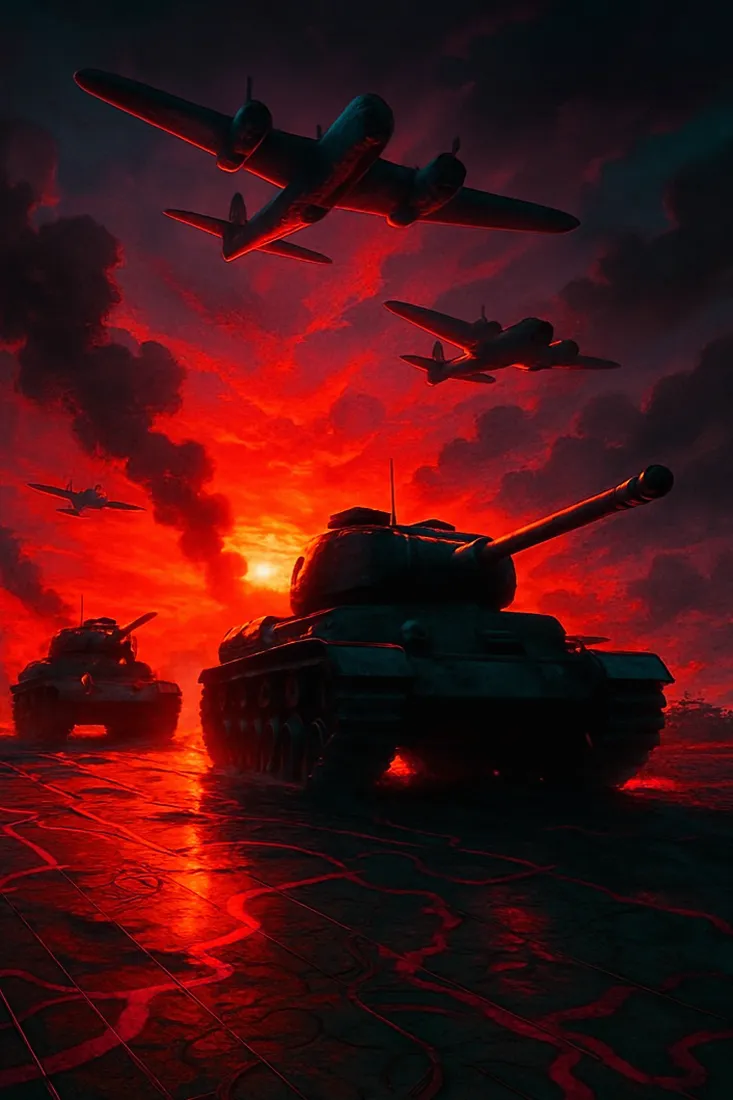
Conflict of Nations takes the real-time world map shared by its Second World War and Great War siblings and drops it into a fictional present-day conflict. Your nation commands the forces of a modern state, and the challenges are distinctly modern: air defence, missiles, long-range strike, insurgents and the constant problem of keeping a coalition pointing in one direction. The official site now heads itself World War 3, and app stores list it as Supremacy: World War 3.
We played several campaigns, some as a regional power and one as a small nation that survived purely by being useful to larger friends. It is the most demanding game here and the one where a single missed threat can unravel a week of work. When it clicks, though, it feels like running a genuinely modern war room.
Western, Eastern and European doctrines
Every nation follows one of three doctrines, and each shapes your forces in a different way. Western units have the most staying power but cost more to research and build. Eastern units are cheaper and quicker to field but more fragile. European forces sit between the two, with well-rounded strengths and a particular knack for defence. Each doctrine even has its own look for its units.
The choice gives every match some asymmetry to play with. A Western player can afford to lose fewer units and must protect the ones they have; an Eastern player can trade more freely. Reading your neighbours’ doctrines becomes a quick way to guess their plans, which is a nice thread connecting this game to Call of War’s similar system.
A modern arsenal with modern headaches
The unit roster is broad: infantry and armour, helicopters and fighters, ships and submarines, and long-range weapons that change how you think about distance. Research unlocks and upgrades them through a detailed tree, and choosing your path is a serious strategic decision. You cannot master everything, and trying to will leave your forces thin.
This is where the game is at its best and its most demanding. Air defence, refuelling ranges, embarking troops onto ships and dealing with insurgents all add layers that the older wars never had. Our first campaign was a blur of learning. By the third we were planning layered defences and coordinated strikes with allies, and the game began to feel like a genuinely modern strategy problem.
Coalitions that live or die on trust
Diplomacy carries the same weight here as in the other real-time maps, perhaps more. Coalitions let players share intelligence and coordinate operations, and in a modern war a well-run coalition can cover gaps that no single nation could. Homeland cities, morale and the economy all reward partners who agree on roles early and stick to them.
The flip side is that coalitions are fragile. Interests diverge, and a partner who has grown strong may decide your territory looks tempting. We learned to keep an eye on allies’ research as well as enemies’. As political drama it is excellent, and it suits players who enjoy the parallels with real alliance politics rather than those who want simple, steadfast friendships.
The weight of a demanding campaign
Campaigns run for days or weeks, and the military systems mean there is always something that could use your attention. Players who can check in several times a day will have an easier time than those who visit once. The mobile app helps, but this remains the most time-hungry of the war maps on our list.
Premium currency speeds research and production and can be felt in competitive campaigns, especially from players who are well into the late game. Free players can still contribute a great deal, particularly in a strong coalition, but should expect a steeper climb than in Call of War. New players should start on smaller or beginner-friendly scenarios and learn the air defence basics before anything else.
Week one in Conflict of Nations
- Choose a nation with a manageable border and a doctrine whose strengths you understand.
- Prioritise economy and a little air defence before buying expensive offensive units.
- Read the unit stats carefully; matching counters is everything in modern combat.
- Talk to neighbours early and look for a small coalition with a clear plan.
- Set up layered defences around your homeland cities before going on the offensive.
What we love
- The deepest and most varied military systems on our entire list.
- Doctrines create real asymmetry between neighbours on the same map.
- Coalition politics feel tense, modern and genuinely consequential.
- Research choices meaningfully shape each campaign’s character.
What grates
- The learning curve is steep, especially air defence and long-range threats.
- Campaigns ask for frequent check-ins to stay competitive.
- Premium speed-ups are more noticeable here than in its older siblings.
Where Conflict of Nations fits a life
Conflict of Nations is for players who follow modern defence and geopolitics, enjoy complex systems and can give a campaign regular attention. It suits Call of War veterans looking for a harder challenge, and anyone who likes coalition politics with real stakes.
Conflict of Nations: the summing-up
Conflict of Nations is the most complex and demanding campaign on our list, and also the deepest military sandbox. Doctrines, a broad modern arsenal and tense coalition politics make it a rich strategic puzzle. It ranks sixth mainly for its steep learning curve and its appetite for time; for the right player, though, it may well be the best game here.