Strategy games simplify history, but the best of them leave you with real questions. Here is how to play them as a curious reader, and which books and ideas make good companions.
What a game can teach that a textbook cannot
A history book can tell you that the great powers of 1914 feared overextension. A game can make you feel it, as provinces you conquered too quickly sink into unrest and your economy sputters. That felt understanding is the particular gift of strategy games. They turn abstract pressures into decisions you have to make yourself, often badly, and remember afterwards.
Geography is the clearest example. After a round of Call of War, the importance of a mountain range or a narrow strait stops being a line in a textbook and becomes something you planned around for a fortnight. Players come away with a mental map of the world that is genuinely useful when they next read about a campaign or a crisis.
None of this makes games accurate. They compress time, simplify economies and let you rewrite outcomes freely. But simplification is how all models work, including the ones historians build. The trick is to notice what the game has chosen to model, and to ask what it has left out. That question alone will make you a sharper reader of history.
Taking the long view in a builder
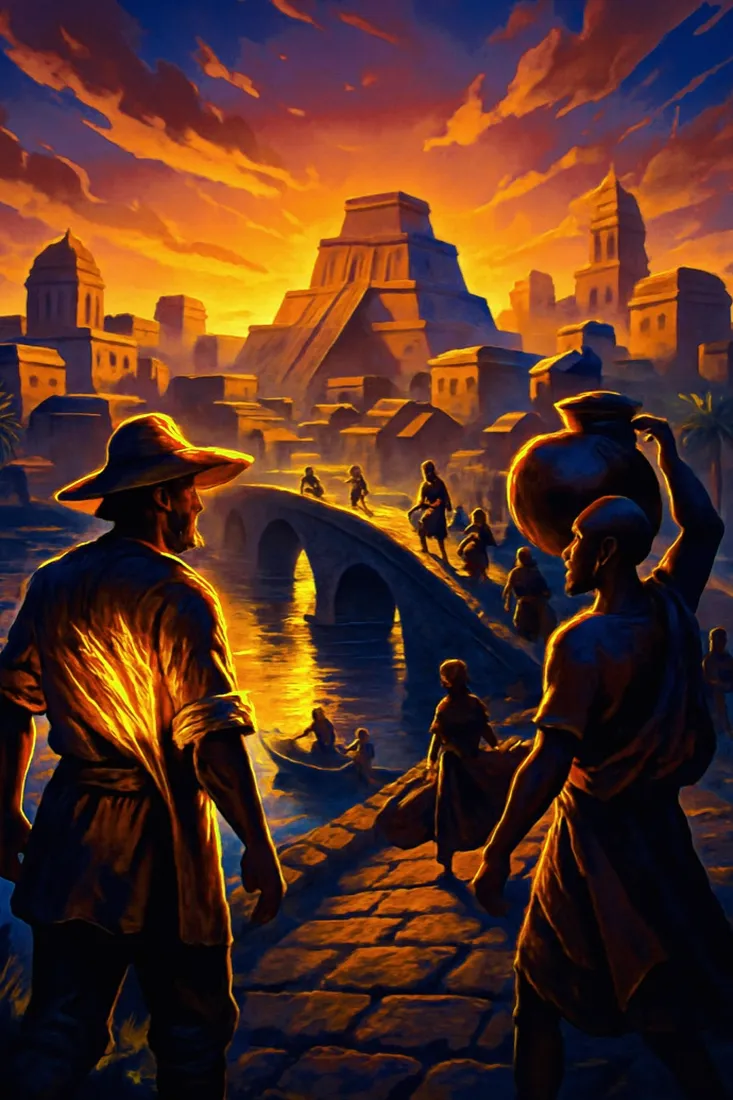
City builders such as Rise of Cultures, Heroes of History and Travian teach a different lesson: the slow accumulation of a society. Watching a settlement move from the Stone Age to bronze working, and from wood and clay to great monuments, gives you a sense of how much has to be in place before the next step is possible.
Rise of Cultures is particularly good at this. Each era asks for new goods and new buildings, and you cannot leap ahead without the foundations. It is a gentle, game-shaped version of an idea that runs through a great deal of popular history writing: that technology, trade and settlement grow together, each depending on the others.
Travian makes the same point socially. A wonder of the world is not built by one player but by an alliance pooling resources over months. It is a reminder that monuments are collective efforts, and it makes reading about real ancient building projects, and the labour and organisation behind them, considerably more vivid.
When a game rewrites history, and why that helps
Every war map lets you change the outcome. An unfancied nation can dominate Europe, a small Balkan state can survive the Great War untouched, a coalition of unlikely partners can win the modern map. Some players find this frustrating; we think it is one of the most useful things these games do.
Counterfactual thinking, asking what might have happened, is a respected tool for understanding why things did happen. When your alternative history goes wrong, you often discover the very constraints that shaped the real one: supply, morale, geography, the difficulty of trusting allies. A failed invasion in a game can teach you why a real one was never attempted.
Heroes of History takes this to a cheerful extreme, mixing figures from every era in a time-travel story. It is not trying to be accurate, and that is fine. Meeting Joan of Arc or Hua Mulan in a squad is a nudge to find out who they really were, and plenty of readers will follow that nudge.
Companion reading for each campaign
For Supremacy 1914, look for accessible histories of the July Crisis and the outbreak of the First World War; the diplomacy will feel uncanny afterwards, especially if you play a power caught between two neighbours. Any good atlas of the Great War will improve your play more than most strategy guides.
Call of War pairs naturally with broad, single-volume histories of the Second World War, especially those that explain logistics and industry as well as battles. You will start noticing how often production and supply, rather than generalship, decided outcomes, and you will build your factories differently as a result. Conflict of Nations rewards reading about modern alliances, defence policy and air power; serious journalism on the subject is plentiful.
For the builders, introductions to the ancient world work best: accessible histories of the Bronze Age, of classical Greece and Rome, and of the Celtic and Germanic peoples whose names Travian borrows. Museum websites and collections are a lovely companion too. Britain’s big national museums put a great deal of their ancient world material online, and it brings the game’s tidy buildings to life. Rise of Cultures players in particular will enjoy putting a real Minoan fresco or a Roman street plan beside their own little city, and noticing what the designers kept, what they softened and what they left out entirely for the sake of a pleasant afternoon.
Keeping curiosity alive between campaigns
The best habit we know is simple: when a game makes you curious, stop and look it up. Why did that province rebel? Was that unit real? What did that city actually look like? A few minutes of reading after a session turns a game into a doorway, and the questions often lead somewhere unexpected.
It also helps to play across periods. Moving from a Bronze Age builder to a 1914 war map and on to a modern coalition game gives you a sense of how warfare, economies and diplomacy have changed, and what has stayed stubbornly the same. Trust, supply and geography appear in every one of the six games on our list.
Finally, talk about it. Alliance chats are full of players who know a great deal about the periods they play, and many are delighted to share. Some of the best history conversations we have had this year started with a question about a game. Curiosity, it turns out, is contagious, and these campaigns spread it nicely.